
Filming an event can get very hectic. For certain shots, there is no second chance. That is why careful preparation is particularly important in event film planning. Because event film planning should be a close collaboration between the organiser and the film crew, this guide is aimed at both sides.
As a rule, the camera team takes care of the detailed shooting schedule. However, it helps the organiser to know which information about the venue and the running order needs to be passed on. After all, the camera team must be well informed about the conditions on site. This article contains the most important points to consider before the shoot for a successful event film. If you follow them, as little as possible is left to chance. This is the best basis for a successful shooting day.
Event film planning: plan early, stay flexible
However, this does not mean that a film crew should shoot an event film strictly according to a fixed plan. Deviating from the original event film planning is often necessary – for example, when the running order changes at short notice. The same applies when creative ideas come up during the event that seem better than the planned ones. Sometimes the best shots even arise from spontaneity. Nevertheless, you should never do without a plan. In case of doubt, you can always fall back on it. A plan that is ticked off step by step ensures that no important shot and no important subject is forgotten. In addition, it helps to keep the time windows for certain shots in mind.
The points of event film planning mentioned here should be dealt with as early as possible. In other words, as soon as the implementation phase of the event is under way, the film crew can also firm up its plans. In the run-up to the event, the schedule may change again and again. However, this does not mean that you should only start planning the film once the event schedule is final. On the contrary: the organiser will be particularly busy just before the date. Therefore, they will be glad if at least the basic framework of the film planning is in place and only needs to be adjusted.

Event film planning: before the shoot
Define the style of the video with the client
To define the desired style of the event film, it is a good idea to exchange sample films that serve as a reference. If the client has seen a video that should serve as a model, they send it to the film crew. Alternatively, the film crew sends the client two or three event films made in slightly different styles. The client can then pick the ones they like best.
In this way, a stylistic direction can be set in advance – for example, how fast the cuts should be, what the colour grading should look like or even specific camera angles. In addition, it can help to choose the background music before the shoot in order to set the basic mood. You can read how an initial consultation with us works on the Video Production Düsseldorf page.
Is an event trailer wanted?
Especially for an event whose ticket pre-sale is still running, it is worth publishing an event trailer in advance. It is then shared via the website and the social media channels of the event or the venue. An event trailer builds anticipation and briefly shows interested people what they can expect from a visit. It usually contains excerpts from previous or similar events. If the client has suitable video material, the option of a trailer should therefore be considered. The rest of this text, however, refers to filming the event itself.
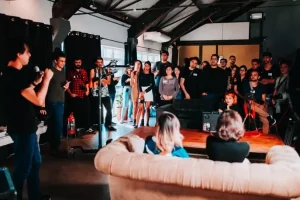
Who exactly should be represented in the video?
Usually, an event film has one client who is showcased in the video and whose ideas are realised. In some cases, however, the client is not a single company. It can also be the organiser of an event or trade fair at which several companies are present. As a filmmaker, you then inevitably have to decide how much space a particular participant gets. In this case, you should always coordinate with the client: is there a sponsor who should be shown a little more often? Or are there companies the client does not want to advertise for involuntarily? To design the video in the client’s interest, it helps to know their relationship with the various participants and which of them they would like to see in the film.
Are there other camera teams or photographers?
At larger events, the client may have booked additional camera teams or photographers. In this case, the teams should definitely talk to each other in advance and coordinate their event film planning. In other words, they should discuss who films or photographs in which area at which time. This way, nobody gets in each other’s way or walks into the picture. Teams from different companies should, of course, also pull together and complement each other as well as possible in the client’s interest.
Visit the event location and clarify important questions
Many events have some kind of rehearsal before the actual date. Alternatively, there may be an event with similar conditions. Both are ideal for getting to know the location while it is in operation. If neither is possible, the camera team should still take a look at the premises in advance. For a successful event film, it is crucial to get to know the location as well as possible. If possible, you should also get to know the people who will be present at the event.
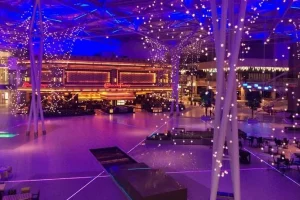
Discuss all important questions about the location in advance
The camera operator and the organiser (or alternatively the location manager or the caretaker of the venue) should discuss the following questions in advance:
- Is there a retreat where equipment can be stored safely and, ideally, with a power connection?
- Where does the main action take place: on a stage, in the middle of the room or elsewhere?
- Which are the best camera positions to capture the action? Are there safe spots for a tripod where nobody bumps into it or accidentally walks into the picture?
- Which sound system is used? Is it possible to connect a recorder to the existing sound system?
- What is the lighting like, especially at the main spots of the event? Does it stay constant or can it change quickly? It can also help to visit the location at a similar time of day to the event – especially if it is mainly lit by daylight.
- Are there any special rules or peculiarities of the location that you should know?
If possible, it can be very helpful to take a few test shots at the location. You can then assess the material at your leisure and correct any weaknesses before the shoot. Some further questions will only arise during the visit. Therefore, it is important to have direct contact with someone at the location who can answer them.

Create a shot list for the event film planning
Even if you only have a few special performances or show acts on the agenda, it is advisable to capture impressions of the event as a whole. For example, shots of the furnishings and decoration, the audience, the backstage action and other interesting features of the event are suitable. They make the video more varied, more meaningful and more entertaining.
It is advisable to always create a shot list or storyline before the event. This way, you think in good time about which angles and details you want to capture, which makes the shoot considerably easier. A shot list is one of the most important parts of event film planning. It provides orientation, and you can check which shots you already have and which you do not.
Be creative and avoid clichés
At a business event, the most obvious thing is to film participants standing at a bar table with a glass of sparkling wine and chatting. There is nothing wrong with that in principle, and such scenes can certainly be included. However, the film should never consist only of these expected and therefore quickly boring scenes. Even when creating the shot list, you can give free rein to your creativity and think of shots that surprise.
List, label and check the equipment you need
Especially at larger events, you are very likely not the only person on site with camera and sound equipment. To clearly recognise which equipment belongs to you after the event, adhesive labels with your initials or company logo are recommended. Confusion is best avoided if you store your own equipment in a clearly separated place. If possible, it should not be stored in the same room as other people’s equipment. Before the shoot, a checklist of the required equipment ensures that you pack everything. After the shoot, it helps you not to leave anything behind. In addition to the main equipment, this list should include the smaller (but no less important) items such as spare batteries, memory cards, cables, adapters and mounts.
AI tools in event film planning (as of 2026)
Artificial intelligence does not do the event film planning for you. However, it saves time on the preparatory work. These uses make sense in practice:
- Drafting the shot list: an AI assistant such as ChatGPT, Claude or Gemini turns the programme of the event into a first draft of the shot list and schedule within minutes. Always check the draft against the real running order and the location.
- Recording the briefing: transcription tools take notes during the preliminary talk and summarise the client’s wishes. As a result, no agreement gets lost.
- Agreeing on the look: an image generator can create mood boards that show the colour scheme and visual style. This does not replace reference films, but it helps with coordination.
You should keep two points in mind. First, do not enter confidential data such as guest lists or internal documents into public AI tools. Second, transparency obligations for AI content have applied in the EU since 2 August 2026 (Article 50 of the AI Act). Anyone who publishes deceptively real AI images, AI voices or AI videos must label them as artificially generated. For an event film made from real footage, this changes nothing. However, it becomes important as soon as individual scenes are artificially generated or altered.
The shooting day itself
If the camera team arrives as early as possible, there is enough time to unpack and set up the equipment calmly and to talk to the organisers. In addition, it makes sense to record some establishing shots before the event. After the event, the daylight is usually no longer suitable for an introduction, or the location clearly shows that everything is over (lights switched off, litter lying around and so on). The earlier you have captured and saved the establishing shots, the better.
If the event takes place in the evening or after sunset, however, it naturally makes sense to record the establishing shots in the evening as well. The time when the guests arrive is always a good moment for this. Such scenes increase the anticipation, especially when it is already reflected in the visitors’ faces. Besides the establishing shot, you should already think during event film planning about which scene will be used as the closing scene in the edit and look specifically for good subjects for it. This does not necessarily have to be a scene at the end of the event, but it should symbolise an ending. A strong opening and closing scene are particularly important for a convincing overall impression of the event film.
You can read which points to consider once the event and the shoot really get going in the article Create an event film.